

Education · Open · Interactive
Physics,taught visually.
Physics.explained is an open-source, interactive physics encyclopedia. Live simulations, a cross-linked concept graph, physicist profiles, and an AI tutor at /ask — all six branches of physics under one roof, all shipped.
▸ Specification
§ 01 · About
A physics librarythat computes.
Physics.explained began as a rejection of static textbook diagrams. Most physics content on the web is written once, rendered flat, and frozen — a pendulum drawn but not swung, an orbit shown but not integrated. Students are left memorising shapes instead of developing intuition.
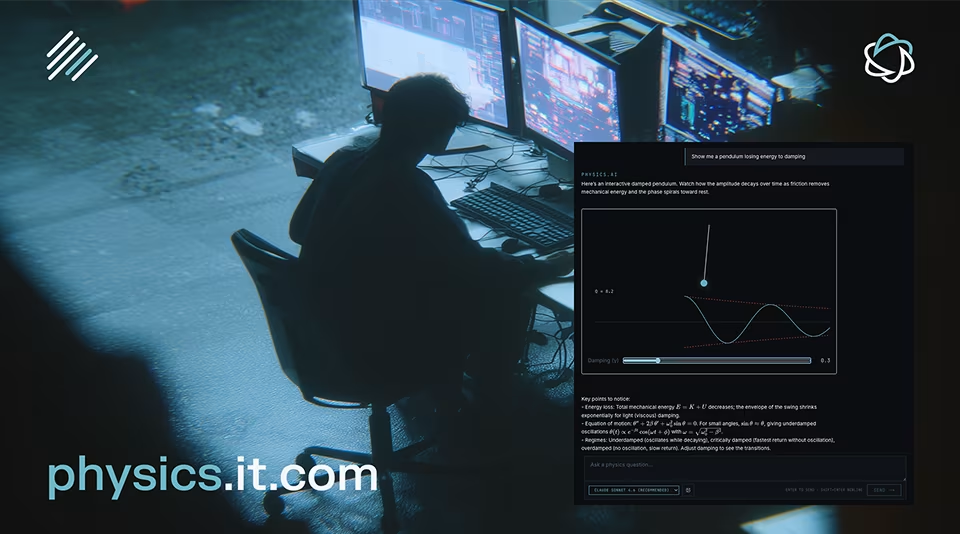
The product treats every diagram as executable physics. Motion is computed at runtime by ODE integrators with numerical tolerances chosen to stay faithful under perturbation. Equilibria are solved by Newton–Raphson root finders. Drag initial conditions, nudge parameters, and the simulation responds as the equations themselves would.
Around the solver core sits a dense reference layer: a cross-linked concept graph spanning classical mechanics, electromagnetism, thermodynamics, relativity, quantum mechanics, and modern physics, plus biographical profiles of the physicists behind every result. Every concept links back to the simulations that demonstrate it and the people who shaped it.
On top of all of that sits /ask — an AI tutor grounded in the same concept graph. Ask anything from "derive Kepler's third law" to "why does entropy always increase?" and get a worked answer with citations back into the library. The full encyclopedia, the solver engine, and the tutor are free and open source.
§ 02 · physics.it.com/ask
A tutor that'sread the whole library.
/ask is an AI tutor wired directly into the concept graph. Ask a question in plain language, get a worked derivation back — with citations to the encyclopedia entries and live simulations that back it up.
Because the tutor is grounded in the library, answers stay inside physics — no hallucinated formulas, no drift. Every response links to the concepts it used, so readers can dig deeper the moment a term feels unfamiliar.
▸ Example prompts
- Derive Kepler's third law from Newtonian gravity.
- Why does entropy always increase?
- Explain the double-slit experiment in 3 sentences.
- Show the Lorentz transform for a boost in x.
§ 03 · What's inside
Four moving parts.
Ask any physics question and get a derivation, a diagram, and cross-links back to the encyclopedia. The tutor is grounded in the same concept graph that drives the simulations, so answers stay inside the library.
Every diagram is a live simulation. Unit-tested ordinary differential equation integrators run in the browser — drag initial conditions, nudge parameters, watch the physics respond.
A searchable, cross-linked encyclopedia of physics concepts — first principles through modern formulations — each entry bound to the simulations that demonstrate it and the physicists who shaped it.
Biographical dossiers for the scientists behind every result, wired into the concept graph so derivations, diagrams, and history sit one click apart.
§ 04 · Design system
Instrument,not illustration.
The visual language borrows from scientific instrumentation: near-black ground, bone foreground, and a small set of saturated accents that carry meaning — cyan for primary actions and states, magenta, amber, and mint for categorical signals across simulations.
▸ Palette
▸ Typography pairing
Used for headlines, figures, and swatch names on physics.it.com. Stands in for Archive Grotesk / General Sans.
Carries long-form reading at 14–17 px. Weights 300, 400, 500, 700.
Reserved for labels, coordinates, code excerpts, and metadata rails.
§ 05 · Branches
All six,all live.
One solver stack powers every branch — the same numerics that integrate a pendulum also run Maxwell's equations, thermal gradients, Lorentz transforms, Schrödinger evolution, and the modern-physics capstones. Every branch ships with its simulations, its concept entries, and its physicist profiles already wired into /ask.
- 01Classical MechanicsLIVE
- 02ElectromagnetismLIVE
- 03ThermodynamicsLIVE
- 04RelativityLIVE
- 05Quantum MechanicsLIVE
- 06Modern PhysicsLIVE
Continue
Open the library.
Every concept, every physicist, every simulation, plus the AI tutor at /ask — all live, all free, all open source.